Many startups and SMEs simply don't have the budget or specialized expertise to staff a full internal audit team. Meanwhile, regulatory scrutiny keeps rising. This creates a real gap: you need audit coverage, but you can't justify a full department.
This guide breaks down what internal audit outsourcing actually is, the models available, the benefits, and how to pick the right partner.
Key Takeaways
- Internal audit can be fully outsourced, co-sourced, or supported through staff augmentation
- 58.7% of Chief Audit Executives report outsourcing all or part of internal audit
- Outsourcing cuts cost and brings specialized expertise while strengthening independence versus in-house teams
- Management always retains accountability, even when the work is outsourced
- Vet partners on certifications, transparent pricing, and written engagement terms before you commit
What Is Internal Audit and Why It Matters
Internal audit is an independent review of a company's operations, internal controls, and risk management processes. It's distinct from an external or statutory audit, which focuses on financial statement accuracy for outside stakeholders. Internal audit exists to serve management and the board directly.
A solid internal audit function does three things: identifies control gaps before they become expensive problems, mitigates fraud risk, and strengthens regulatory compliance. More than a compliance checkbox, it works as a feedback loop for how the business actually runs.
Internal audit's fraud-detection role is measurable. According to the Center for Audit Quality's summary of ACFE data, internal audit detected 14% of fraud cases, ahead of management review (13%) and external auditors (just 3%). Tips remain the top detection method, but internal audit is consistently one of the strongest structured controls a business can put in place.
Three Types of Internal Audits
- Compliance audits — check adherence to laws, regulations, and internal policies
- Operational audits — evaluate the efficiency and effectiveness of business processes, from procurement to fulfillment
- Financial audits — verify the accuracy of financial records and reporting, catching errors or misstatements early

Most growing companies need a mix of all three, though the weighting shifts depending on industry and growth stage.
Can Internal Audit Be Outsourced? Understanding the Models
Yes. Internal audit can be fully outsourced, co-sourced, or supported through staff augmentation. Management always retains ultimate accountability for an effective internal audit function, even when external providers handle the work.
The Institute of Internal Auditors states this clearly in Standard 2070: the organization stays responsible when a third party runs the function.
Four models cover most situations:
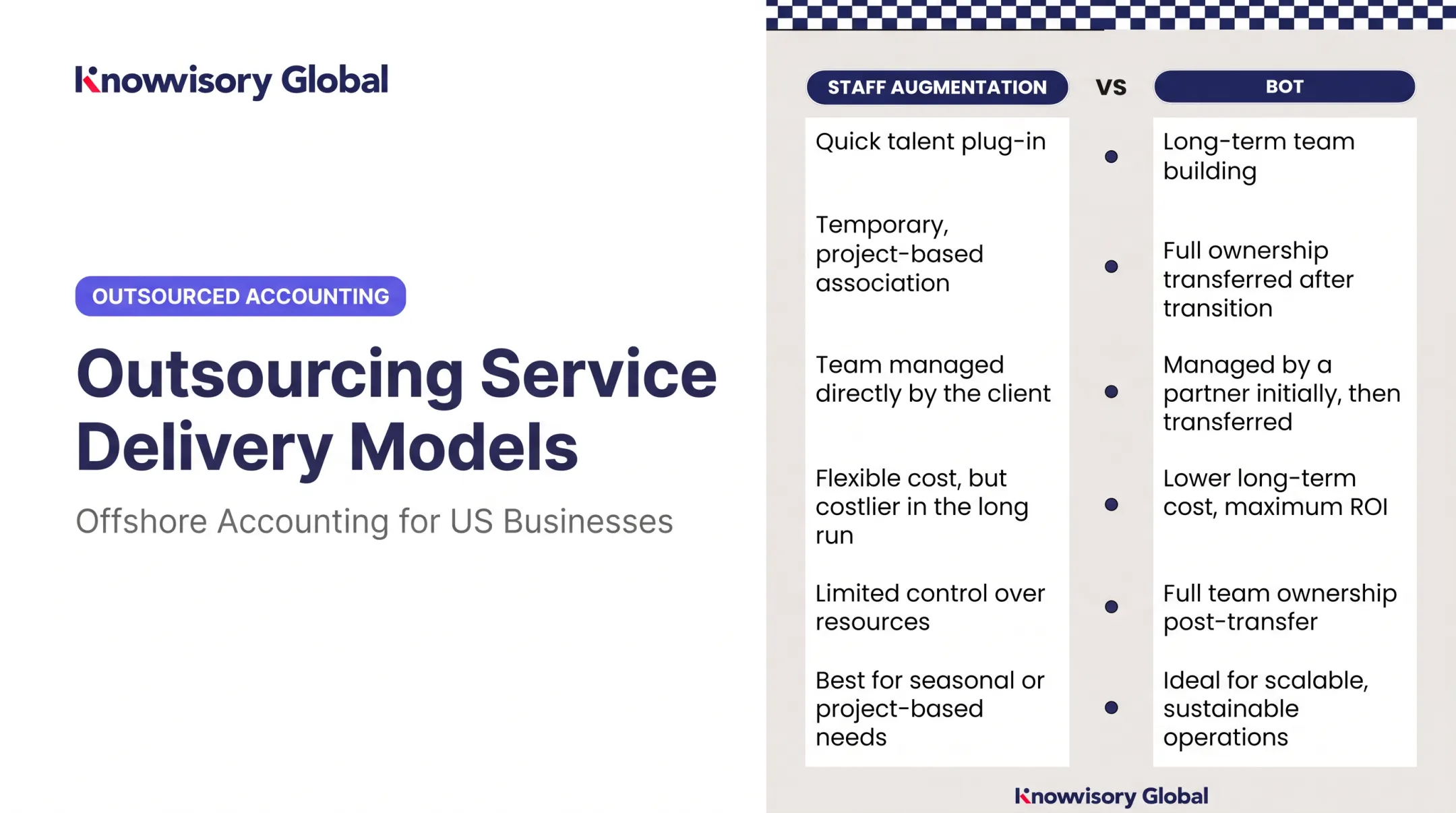
- Full Outsourcing — An external firm runs the full internal audit function, from planning through reporting
- Co-sourcing — In-house staff partner with external specialists on defined projects or skill gaps
- Staff Augmentation — Temporary external resources join your team for peak workloads or vacancies
- Subcontracting — A third party handles short-term, narrowly scoped audit projects

Which model fits depends on company size, budget, in-house expertise, and audit complexity. A 20-person startup with no compliance history needs something very different from a 200-person fintech facing SOX requirements.
Key Benefits of Outsourcing the Internal Audit Function
Cost savings top the list. Building an in-house audit team means salaries, benefits, training, and technology overhead that most SMEs can't justify for a function that isn't full-time work year-round.
Peer-reviewed research published in Auditing: A Journal of Practice & Theory found that outsourcing internal audit is associated with lower overall audit fees compared to keeping the function in-house.
Beyond cost, outsourcing brings:
- Cross-industry expertise and niche skills such as IT audits or AML/CFT compliance that are hard to build internally
- Stronger independence, because outsourced internal auditors sit outside office politics and are easier to rotate for objectivity
- Flexible capacity you can scale up or down for seasonal demand, growth spurts, or one-off projects
- Access to audit technology that most SMEs cannot justify buying and maintaining alone

The Technology Advantage
Manual audit processes miss patterns automated tools surface in minutes. For startups and lean finance teams, that gap shows up as delayed findings, missed exceptions, and slower reporting cycles.
KnowVisory Global supports outsourced internal audit and finance functions with AI-driven anomaly detection, automated reporting, and real-time dashboards, paired with US GAAP-compliant practices. Startups and SMEs get operational visibility that larger companies usually build in-house, without the fixed overhead.
Examples of Internal Audit Services and the Four Main Types of Audits
Internal audit outsourcing typically covers services like:
- Risk assessments that identify where controls, processes, or exposures need attention
- SOX compliance testing for key financial reporting controls
- IT and cybersecurity audits covering access, systems, and data safeguards
- Fraud investigations when irregularities or tip-offs surface
- Internal controls reviews that test design and operating effectiveness
KnowVisory Global supports these needs with focused internal audit work, including:
- Comprehensive risk assessment to flag critical business risks
- Compliance testing and assurance across SOX, US GAAP, and IFRS requirements
- Internal controls evaluation to assess control design and help prevent fraud
How Internal Audit Differs From Other Audit Types
Businesses encounter four distinct audit categories:
| Audit Type | Purpose | Who Performs It |
|---|---|---|
| Internal audit | Reviews operations, controls, and risk management | In-house team or outsourced provider |
| External/financial statement audit | Verifies financial statement accuracy for stakeholders | Independent CPA firm |
| IRS/tax audit | Examines tax returns for accuracy and compliance | IRS |
| Compliance/regulatory audit | Checks adherence to specific laws and regulations | Internal or external auditors |

Internal audit outsourcing is not a tax engagement or a statutory financial statement audit. It is an advisory, risk-focused function for management—not an independent opinion issued for external stakeholders.
How to Choose the Right Internal Audit Outsourcing Partner
Not every provider is equipped to handle this work well. Look for these markers:
- Relevant certifications — CPA, CA, or equivalent credentials, plus proven experience in your specific industry
- Clear engagement terms — scope, fees, reporting responsibilities, and data/workpaper ownership should all be defined before work starts
- Transparent, fixed pricing — no hourly surprises or hidden fees buried in the fine print
- Strong communication and technology — regular check-ins, defined escalation paths, and tools that give you visibility into progress
A good scoping process should lock in the following within the first couple of weeks:
- Workflows and handoffs
- Quality standards
- Reporting formats and cadence
Anything less leaves too much ambiguity.
KnowVisory Global's approach reflects these practices. The firm is led by Sanjeev Kumar, a US CPA and Indian Chartered Accountant (CA), and offers tailored pricing with no hourly rates or hidden fees.
Its professionals work as an extension of the client's team rather than a detached vendor. That setup gives findings the context and follow-through they need after the report is delivered.
Frequently Asked Questions
Can internal audit be outsourced?
Yes. Internal audit can be fully or partially outsourced through models like full outsourcing, co-sourcing, or staff augmentation. Management still keeps oversight responsibility under every model.
What are the benefits of outsourcing the internal audit function?
You typically save versus building an in-house team and gain specialized expertise on demand. External reviewers also improve objectivity, and you can scale support up or down as needs change.
What does an internal audit function do?
It independently reviews your controls, risk management, and operations to find gaps and recommend improvements. It reports to management and the board—not external stakeholders.
What are some examples of audit services?
Common examples include risk assessments, SOX compliance testing, IT and cybersecurity audits, fraud investigations, and internal controls reviews.
What are the three types of internal audits?
Compliance audits, operational audits, and financial audits. Most businesses need some combination of all three.
What are the four main types of audits?
Internal audits, external/financial statement audits, IRS/tax audits, and compliance/regulatory audits. Each serves a different purpose and answers to a different audience.